
NAPS ELECTROPLATING SYSTEMS
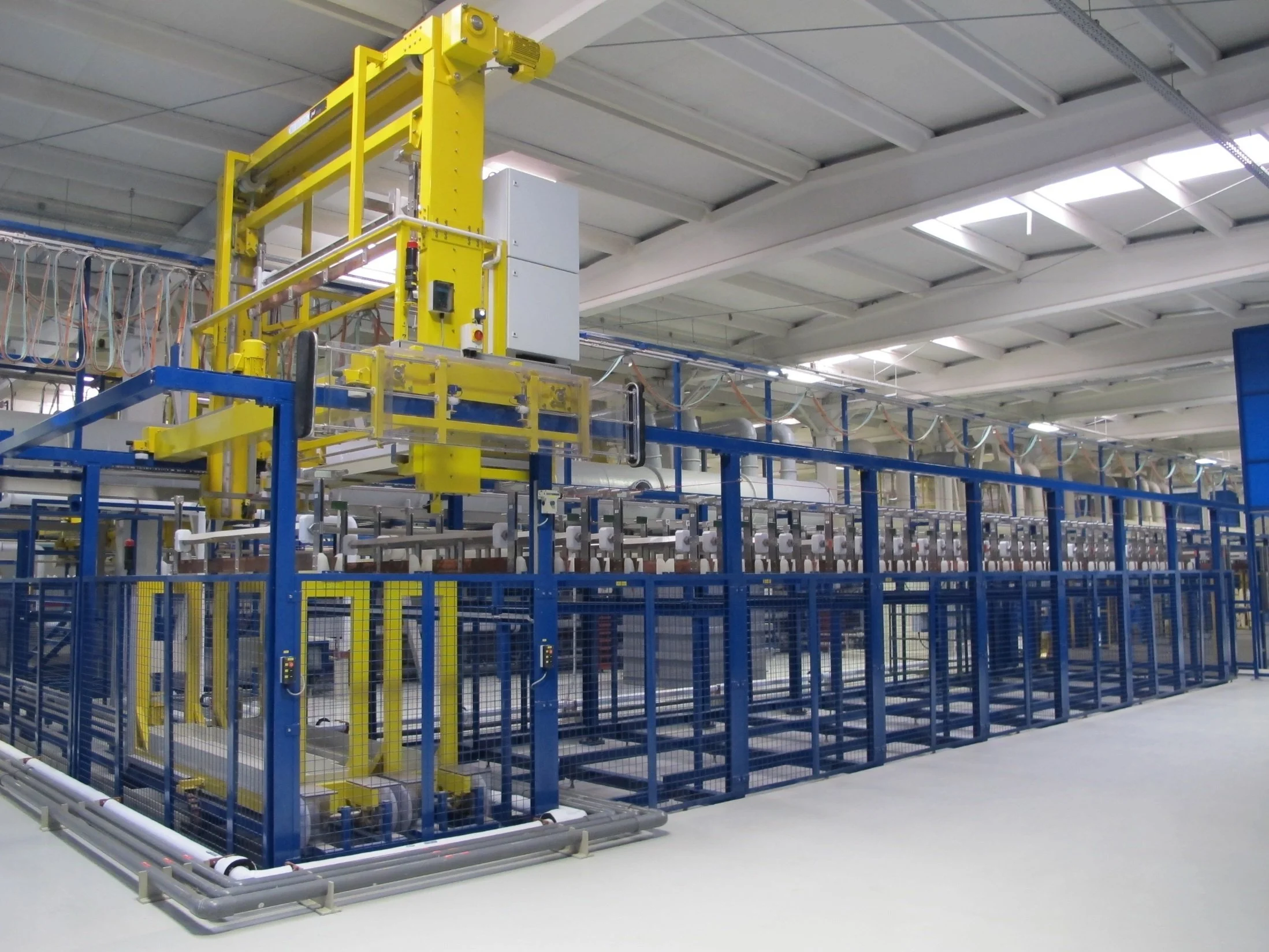
A NAPS Electroplating System is executed under the internal quality management methodology that governs all North American Process Systems projects. Process definition, interfaces, and control logic are established early, then carried through fabrication, installation, and commissioning without being reinterpreted at the end. The system is built to support traceability, accountability, and operational visibility in the way it runs, in the way it is maintained, and in the way it is verified over time.
Electroplating does not reward assumptions. Chemistry families evolve, OEM and customer specifications tighten, substrates vary, and small design choices cascade into yield loss, rework, or instability when the line goes to rate. NAPS engineers each electroplating system with the client’s chemical supplier engaged during design, and with technical reference discipline applied to power delivery, anode strategy, agitation, filtration, material compatibility, and rinse management. That combination of field experience and rigorous study is how process capability becomes repeatable production performance.
A NAPS Electroplating System is defined as a controlled production platform, not a tank sequence. Electrical performance, chemical stability, environmental integration, and data capture are aligned so the operation can maintain traceability through production life, enforce parameter control with clear accountability, and sustain visibility for internal control and audits.
Engineered Electroplating Systems for Controlled Production Performance
Electroplating encompasses one of the most chemically and electrically diverse disciplines in surface finishing. Nickel systems alone range from Watts and sulfamate formulations to high-speed, matte, bright, composite, and particle-reinforced variants. Chrome programs span functional hard chrome, legacy hexavalent decorative chrome, and increasingly adopted trivalent systems, including specialized finishes such as black chrome. Zinc, copper, alloy deposits, plating on plastics, and electroless processes further expand the operating landscape. Each chemistry introduces different electrical demands, bath control sensitivities, substrate interactions, and environmental considerations.
A NAPS Electroplating System is engineered around these realities. Line design is driven by metal selection, substrate type, OEM and specification requirements, and production objective, not by a generic tank sequence. Current density distribution, rack or barrel configuration, auxiliary anode strategy, and rectifier sizing are defined in direct response to thickness targets, throwing power requirements, and part geometry. In high-strength steel applications, hydrogen embrittlement control and post-plate processing become integral to system layout. In decorative automotive programs, the industry-wide shift toward trivalent chrome requires close coordination with chemical suppliers and environmental controls from the outset.
North American Process Systems works directly with the client’s chemistry provider during engineering and design to ensure the line is configured to support the specific formulation in use. Agitation strategy, filtration capacity, temperature control, material compatibility, and rinse cascade design are aligned to supplier parameters rather than assumed from a generic specification. This approach ensures the chemistry performs as intended under sustained production conditions.
Electroplating lines that appear similar on paper often behave very differently in operation. Permanganate preparation stages for plastic activation, high-throughput automotive zinc programs, precision aerospace nickel systems, and functional hard chrome lines each impose unique control and environmental demands. A NAPS Electroplating System is built with these distinctions in mind, integrating electrical performance, chemical management, and production logistics into a stable manufacturing asset.